
Agilex BUNKER MINI 2.0
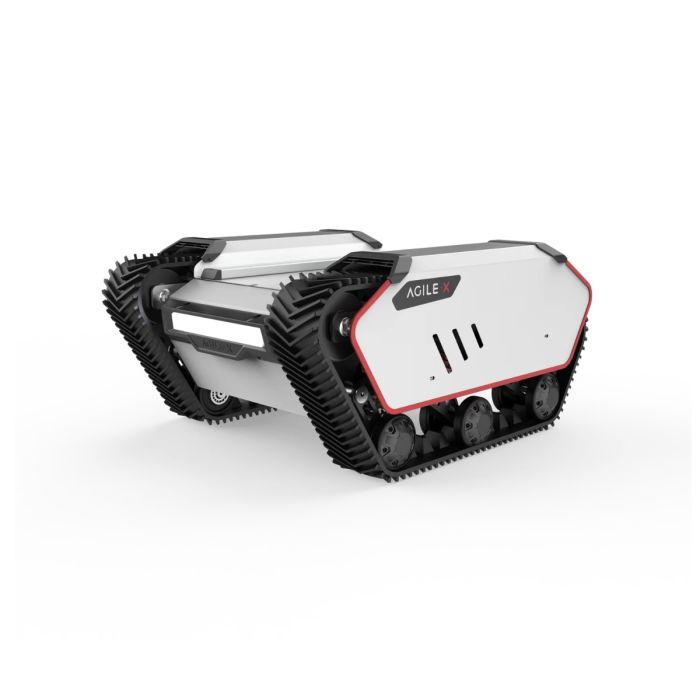
In stock
- BRAND:
- AGILEX
- PART #:
- BUNKER MINI
- ORIGIN:
- China
- AVAILABILITY:
- SUBJECT TO AVAILABILITY
- SKU:
- AgileX-BUNKER-MINI
Agilex BUNKER MINI 2.0
Most robot projects begin with the same stubborn question: where do you put the brain when the ground will not cooperate? The Agilex BUNKER MINI 2.0 answers it from the bottom up. It is a tracked chassis built to carry your ideas, your sensors and your code across rough, wet and awkward terrain, so your team can spend its time on the robot's purpose and not on its wheels.
The product is available through this page, by quotation.
Background
AgileX and the road to a compact tracked platform
AgileX builds mobile robot platforms and development kits for engineers, researchers and integrators. Its range runs from wheeled and tracked chassis to robotic arms and complete kits, and it is listed in our AgileX category. The BUNKER line is its tracked family. The BUNKER MINI 2.0 is the smaller, more manageable member of that family. A team can move it, test it and iterate on it without a large crew or a heavy transport plan.
Tracked machines have long been the choice where wheels slip or stall: loose ground, steps, debris and wet surfaces. AgileX takes that proven idea and packages it as a development base with a defined communication standard, open-source software content and rails for mounting equipment. That packaging is the real story. You are not buying a finished robot for one job. You are buying a dependable starting point for many jobs.
Positioning and key technology
The manufacturer describes the BUNKER MINI 2.0 as an all-round tracked chassis vehicle for industrial applications. It is meant for the development of special robots, such as inspection and exploration robots, EOD rescue robots, special shooting platforms and special transport vehicles. In other words, it sits between a hobby base and a purpose-built machine: robust enough for field work, open enough for custom engineering.
Three technical choices define it. First, two brushed DC motors of 250 W each drive the tracks. Second, a CAN interface, built on the CAN2.0B standard at a 500K baud rate with MOTOROLA message format, lets your own controller command the vehicle. Third, AgileX provides a library of open-source content, including an SDK and ROS material, so software teams do not start from a blank page. The BUNKER MINI also offers aluminum T-slot rails for secure mounting of external sensors or kits.
Technical Specifications
| Specification | Value |
|---|---|
| Dimensions | 660 x 584 x 340 mm |
| Weight | 55 kg |
| Track width | 100 mm |
| Maximum load capacity (BUNKER MINI manual) | 25KG |
| Maximum speed | 0~1 m/s |
| Climbing ability | 30° (no payload) |
| Obstacle surmounting capacity | 120 mm |
| Motor | 250 W x 2 (brushed DC motors) |
| Battery | 24 V 30 Ah lithium battery |
| Charge time | 3–4 hours |
| Operating temperature | -20 to ~60 °C |
| Protection level | IP67 |
| Communication interface | CAN |
| CAN standard | CAN2.0B, 500K baud rate, MOTOROLA message format |
| Remote control | FS remote control, equipped from the factory |
| Mounting | Aluminum T-slot rails (BUNKER MINI) |
Specifications as published by the manufacturer; confirmed against the datasheet at quotation.
The manufacturer has not published the runtime on one charge, the onboard sensors, the wireless connectivity or the suspension type; they are confirmed at quotation.
What makes the BUNKER MINI 2.0 a good base for custom robots?
A development chassis earns its place by what it lets you skip. With the BUNKER MINI 2.0 you skip the design of a drive train, a power system and a protected enclosure. The vehicle arrives with two 250 W brushed DC motors, a 24 V 30 Ah lithium battery and an IP67 protection level. That rating speaks to dust and water, which matters on a coastal site, a wet yard or a washed-down plant floor.
The second advantage is how you talk to it. The CAN interface follows the CAN2.0B standard at a 500K baud rate, and the message format is MOTOROLA. Your engineers can read that definition, write a controller against it and test the result. The vehicle is also compatible with sensors and peripherals that support the CAN protocol, and AgileX provides open-source SDK and ROS content. Teams already working in ROS will feel at home quickly.
The third advantage is mounting. Aluminum T-slot rails on the BUNKER MINI let you fix external sensors or kits securely and move them as the project changes. That is far easier than drilling a custom plate for every new idea.
How does the BUNKER MINI 2.0 handle rough ground?
The figures describe a vehicle meant for real terrain. It climbs 30° with no payload and surmounts obstacles of 120 mm. The tracks are 100 mm wide, and the vehicle has a footprint of 660 x 584 x 340 mm and a weight of 55 kg. It moves at 0~1 m/s, a pace that suits inspection, careful exploration and sensor work, where steady movement matters more than raw speed.
The operating temperature range of -20 to ~60 °C covers a wide span of climates. For a Caribbean operator, the upper end of that range is the figure to note, together with the IP67 protection level. Recharging takes 3–4 hours, so planning a working day around the 24 V 30 Ah pack is straightforward once you know your own duty cycle. Ask for the runtime on your own load with the quotation.
The BUNKER MINI manual states a maximum load capacity of 25KG. Plan your sensors, computer and tooling inside that figure.
Who is the BUNKER MINI 2.0 for?
University and institute labs are the natural first group. They need a chassis that students can program through ROS and CAN, and that survives repeated field trials. Research groups in robotics, autonomy and perception will value the open SDK and ROS content.
Integrators and system builders form the second group. If you are developing an inspection robot, an exploration vehicle, an EOD rescue platform, a special shooting carrier or a special transport vehicle, the BUNKER MINI 2.0 gives you a ready foundation. You add the payload and the intelligence; the chassis supplies motion and power.
Industrial teams with compact sites make up the third group: utility yards, plant corridors, outdoor installations and similar places where a smaller machine is easier to deploy. If your application needs a larger or heavier-duty platform, look at the sibling Agilex BUNKER PRO 2.0 and compare it with this one when you request your quotation. Our team can help you judge which fits your payload and terrain.
What is the BUNKER MINI 2.0 used for?
- Inspection and exploration. Carry cameras and sensors through tight, uneven or hard-to-reach areas, and bring back data.
- EOD rescue development. Build a tracked platform for hazardous-task robots, with the controller of your choice on the CAN interface.
- Special shooting. Mount camera equipment on a low, stable tracked base for specialized filming work.
- Special transport. Move equipment or materials within the load limit across rough ground.
- Research and teaching. Give students and researchers a robot they can program through the open SDK and ROS content.
- Sensor and kit testing. Fix new sensors to the T-slot rails and evaluate them on a real moving vehicle.
Pricing and Availability
We do not print prices on this page. Quotation is the way to buy: tell us your application, your quantities and your destination, and we respond with an offer built around your project. Delivery, customs and support are arranged with the quotation. The Agilex BUNKER MINI 2.0 is available on this page.
Frequently Asked Questions
What is the Agilex BUNKER MINI 2.0?
It is an all-round tracked chassis vehicle for industrial applications. It is designed as a base for developing special robots.
How heavy a load can it carry?
The BUNKER MINI manual states a maximum load capacity of 25KG. The vehicle itself weighs 55 kg.
How is it controlled?
It is equipped with an FS remote control from the factory. For your own control software, it offers a CAN interface following the CAN2.0B standard at a 500K baud rate, with MOTOROLA message format.
Does it support ROS?
AgileX provides a library of open-source content, including an SDK and ROS material. The vehicle is compatible with sensors and peripherals that support the CAN protocol.
Can it work in wet or dusty conditions?
Its protection level is IP67, and its operating temperature range is -20 to ~60 °C.
How long does it run on one charge?
The battery is a 24 V 30 Ah lithium pack that charges in 3–4 hours. Ask for the runtime figure with your quotation.
Where can I buy the Agilex BUNKER MINI 2.0 and what does it cost?
You can buy it through this page by requesting a quotation. The price is given in the quotation, together with delivery, customs and support arrangements.
Summary
The question at the start was where to put the brain when the ground will not cooperate. The Agilex BUNKER MINI 2.0 gives a practical answer: a tracked, IP67-protected chassis with a 24 V 30 Ah lithium battery, CAN control, open SDK and ROS content, and T-slot rails ready for your equipment. It will not decide your application for you, and that is its strength. If you are building an inspection, exploration, rescue, filming or transport robot, this page is the starting point.


